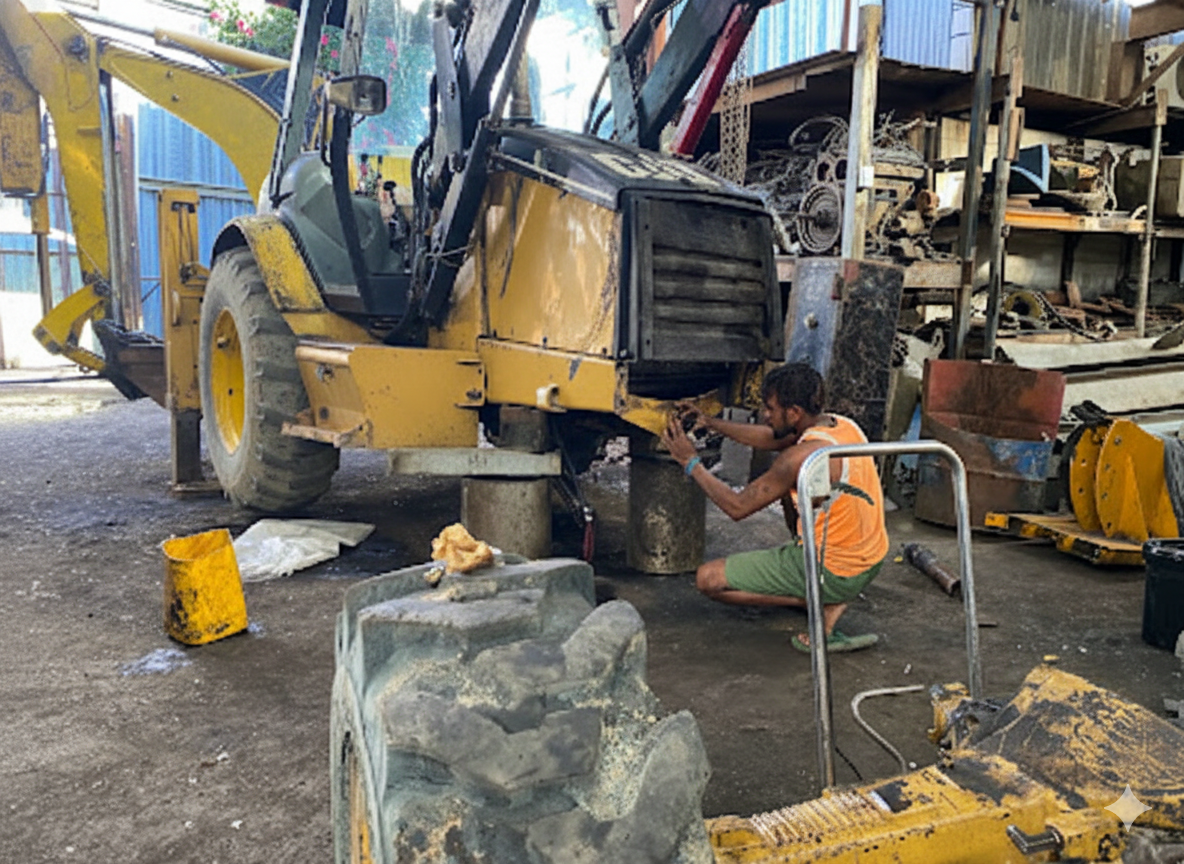
Papua New Guinea’s economy is built on a foundation of immense industrial power. From the resource-rich highlands of the Ok Tedi and Porgera mines to the vast forestry operations in remote provinces and the booming construction projects reshaping Port Moresby, heavy machinery is the engine of the nation’s GDP.
In these critical sectors—mining, logging, agriculture, and construction—every hour of operation is measured in thousands of Kina. But this engine is brutal, and the environment it operates in is one of the most challenging on Earth.
What happens when a critical hydraulic hose bursts on an excavator at a remote logging camp, or a bulldozer’s transmission fails on a crucial construction deadline in the National Capital District (NCD)?
The answer is catastrophic downtime.
In an environment as logistically demanding as Papua New Guinea, waiting for a standard repair isn’t just an inconvenience; it’s a financial crisis. This is why on-call machinery repair isn’t a luxury—it’s an essential, non-negotiable component of any successful industrial operation in the country.
📈 The Crippling Cost of “Waiting for Repair”
Downtime is a term that sounds passive, but in PNG’s heavy industries, it’s an aggressive, cascading failure. The true cost of a single downed machine is rarely just the price of the replacement part.
1. The Direct Financial Hemorrhage
Studies from the global mining industry show that a single hour of unplanned downtime for a critical piece of equipment can cost a company upwards of $180,000 (USD) per incident. When a haul truck, excavator, or processing plant component stops, the entire production chain grinds to a halt. In construction, this translates to massive financial penalties for missing project deadlines.
2. The Logistical Nightmare
This is where PNG’s unique challenges multiply the cost.
- Extreme Remoteness: Many mining and forestry sites are not accessible by road. A failed machine can’t simply be “towed to the shop.”
- Challenging Terrain: Rugged mountains, extreme weather, and flash floods can make just reaching the equipment a multi-day operation.
- Infrastructure Gaps: Even in the NCD, getting a machine from a site like Bomana or Granville to a workshop can be a major logistical hurdle, involving costly transport and permits.
3. The Ripple Effect of Inefficiency
A single breakdown has a devastating ripple effect:
- Idle Workforce: A highly-paid crew of operators, spotters, and support staff are left standing idle.
- Project Delays: The entire project timeline is threatened, impacting contracts, investor confidence, and supply agreements.
- Collateral Damage: A failed hydraulic system that isn’t addressed immediately can lead to further damage to pumps, motors, and seals, turning a simple repair into a complete system overhaul.
- Safety Hazards: A non-operational or “limping” machine can become a serious safety risk to personnel, especially if it fails under load.
In this high-stakes environment, the old model of “break-then-fix” is obsolete. The new model, essential for survival and profitability, is built on immediate, on-call response.
🔧 What is On-Call Machinery Repair?
On-call machinery repair is a service model designed to bring the workshop to the machine, not the other way around. It’s an emergency-response system for heavy equipment.
Instead of your team diagnosing a problem, trying to source parts, and then scheduling a repair technician (a process that could take days or weeks), an on-call service works like this:
- The Call: Your site manager identifies a problem and makes one phone call.
- Triage & Diagnosis: A skilled technician provides an initial diagnosis over the phone.
- Dispatch: A fully-equipped service vehicle with a professional mechanic and diagnostic tools is dispatched to your location—whether it’s a construction site in Port Moresby or a more remote operation.
- On-Site Solution: The technician performs advanced diagnostics on-site, identifies the root cause, and executes the repair. This could involve anything from fabricating a new hydraulic hose from the truck to repairing motors or welding damaged steel components.
- Operational Recovery: Your machine is back online in hours, not weeks.
This model fundamentally changes the equation, shifting control from the problem back to the project manager.
⭐️ 5 Reasons On-Call Repair is Essential in PNG
1. It Drastically Minimizes Financial Bleed
The primary benefit is speed. An on-call service partner, especially one based locally in the NCD like QSJ Holdings Ltd (Hydraulic Station), can be on your site in the shortest possible time. By compressing the repair window from days to hours, you directly save tens or even hundreds of thousands of Kina in lost productivity. This rapid response is the single highest-impact action you can take to protect your revenue.
2. It Solves the “Remote Location” Problem
For much of PNG, logistics are the biggest enemy. Transporting a 40-tonne excavator is a monumental expense and risk. On-call mobile service eliminates this. The technician’s service truck is the asset that moves, not your multi-million-Kina machine. This is vital for operations outside the immediate NCD, but it’s just as critical for busy, confined construction sites in the city where moving equipment is a major disruption.
3. It Provides Access to Specialized Expertise
Modern heavy machinery is complex. A problem that looks like a simple leak could be a symptom of a deeper hydraulic or electronic issue. Most on-site crews are not equipped with the specialized diagnostic tools or the cross-disciplinary experience to find the root cause.
A professional on-call service brings that expertise to you. They have technicians who are not just “parts fitters” but true diagnosticians. They can:
- Run diagnostics on machines and vehicles.
- Properly repair and press hydraulic hoses.
- Service and repair various motors.
- Even perform on-site welding or lathe machine work.
This “one-stop shop” capability means the problem is fixed correctly the first time, preventing repeat failures.
4. It Improves Site Safety and Prevents Collateral Damage
A “quick fix” by an untrained operator to get a machine running can be incredibly dangerous. It can lead to improper hydraulic hose fittings, failed safety seals, or structural weaknesses. An on-call professional ensures the repair is done safely and to manufacturer specifications, protecting your people and your equipment.
Furthermore, a fast, professional diagnosis prevents a minor issue (like a failing oil seal) from turning into a major one (like a completely seized motor). It contains the problem before it can spread.
5. It Enables Proactive, Not Just Reactive, Maintenance
The best on-call partners become part of your preventive maintenance (PM) strategy. While the technician is on-site for one repair, they can use their diagnostic tools to inspect other “at-risk” machines.
They can spot a failing hose before it bursts or identify a motor that is underperforming. This allows you to schedule a planned replacement during off-hours, transforming a potential unplanned shutdown into a simple, controlled planned maintenance task. This proactive approach is the hallmark of a high-efficiency operation.
Your Partner in Uptime: QSJ Holdings Ltd (Hydraulic Station)
To make this model work, you need a partner who is reliable, skilled, and—most importantly—local.
Based in Bomana, NCD, QSJ Holdings Ltd (Hydraulic Station) is built from the ground up to be this essential partner for PNG’s heavy industries. We are not just a parts supplier; we are a full-service maintenance and repair solution.
Our “On call service” is at the very core of our business. We understand the crippling cost of downtime and are structured for rapid response.
We provide the comprehensive, on-the-ground support that PNG’s industries demand:
- Heavy Machinery Specialists: We repair and maintain all various heavy machines and vehicles.
- Hydraulic Experts: We are a true “Hydraulic Station,” with full capabilities for hydraulic hose repairments and a hydraulic press.
- Advanced Diagnostics: We find the root cause of the failure with diagnostics for machines and vehicles.
- Complete Workshop Capabilities: From changing an oil seal to repairing motors and providing welding and lathe machine services, our skillful and experienced team can handle the job.
Conclusion: Don’t Bet Your Project on “Hope”
In the challenging, high-stakes environment of Papua New Guinea, “hoping” a machine doesn’t break down is not a strategy. It’s a gamble you will eventually lose.
The only way to build resilience, protect your profitability, and keep your projects on schedule is to have a robust, on-call machinery repair strategy in place. It’s the ultimate insurance policy against downtime.
Don’t wait for the silence of a failed engine to make the call. Be proactive. Partner with a team that is ready to move the moment you need them.
Is your operation prepared for an unexpected breakdown? Contact QSJ Holdings Ltd (Hydraulic Station) today to learn how our on-call repair and maintenance services can protect your uptime and keep your project moving.
- Email: qsjholdingspng@gmail.com
- Address: Section 0116, Lot 3122, Bomana Granville, NCD, POM
- P.O. Box: 2503 VISION CITY 1131, National Capital District